
From Aluminum Sheets to a Finished Pickup Canopy: Inside the KASENDE Factory
A high-quality aluminum pickup canopy is not simply made by joining several metal panels together.
Its strength, fitment accuracy, appearance, weather resistance and service life are determined by every stage of production—from aluminum sheet preparation and precision panel processing to CNC bending, edge forming, structural assembly, surface finishing and final inspection.
KASENDE is a professional aluminum pickup canopy manufacturer providing factory-direct production, OEM and ODM customization, sample orders and wholesale solutions for international customers.
Our pickup canopies are developed for work, camping, overlanding, tool storage, commercial fleets and automotive accessory
distribution.
Aluminum Sheet Preparation
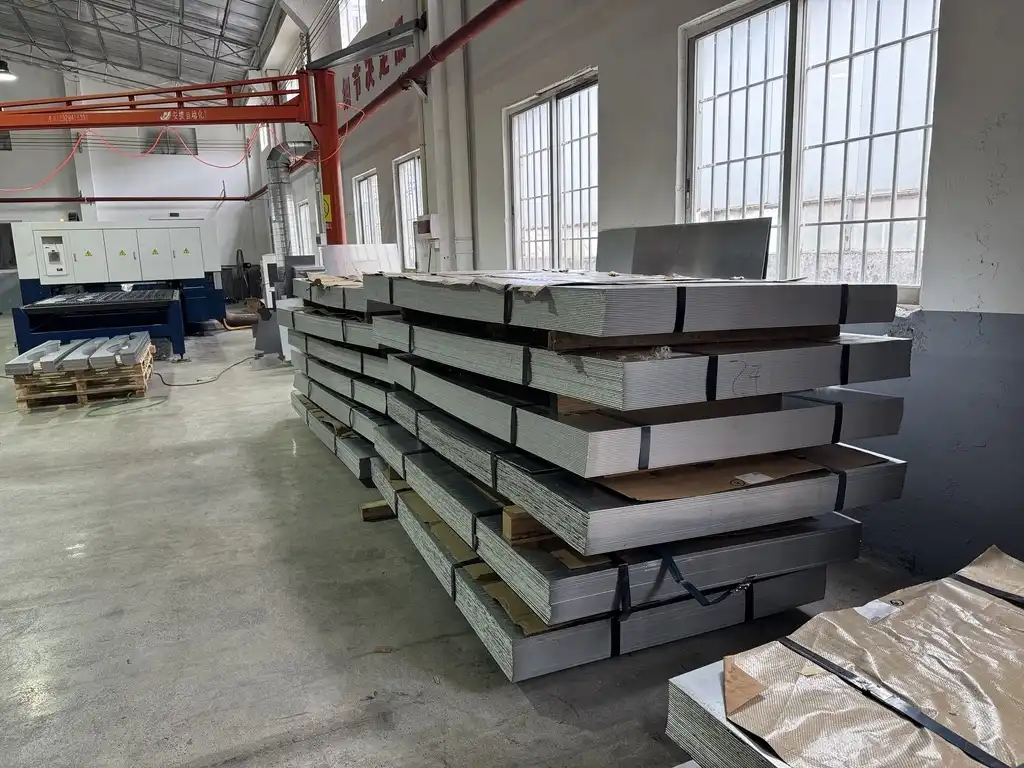
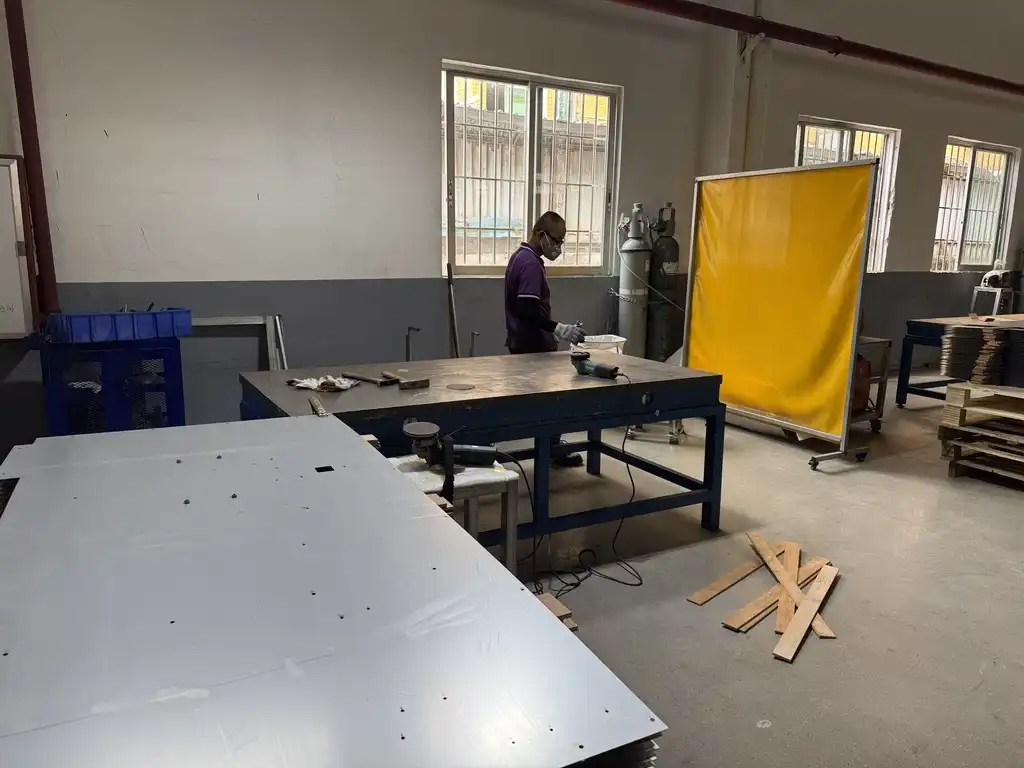
The KASENDE production process begins with carefully prepared aluminum sheets.
In our workshop, aluminum sheets are stored in organized stacks, separated by wooden supports and secured with straps.
This storage method helps reduce deformation, impact damage and surface scratches while the material is being stored or transferred between production stages.
Aluminum is widely used for professional pickup canopy manufacturing because it offers a practical combination of strength, lower weight and corrosion resistance.
Compared with a similar steel canopy, an aluminum pickup canopy can help reduce:
Overall product weight
Long-term load on the pickup truck
Handling difficulty during installation
Weight-related international shipping costs
Corrosion risks in humid or coastal environments
For customers using their vehicles for outdoor work, camping or long-distance travel, aluminum provides a durable structure without adding unnecessary weight.
2. Precision Panel Processing
After the aluminum sheets are prepared, each panel is processed according to the product drawings and vehicle fitment requirements.
A pickup canopy may contain multiple structural components, including:
Roof panels
Side panels
Front and rear frames
Lift-up door panels
Window openings
Lock mounting positions
Hinge positions
Internal reinforcement parts
Sealing surfaces
Accessory mounting points
When a customer requests additional features such as side cabinets, a camping kitchen, LED lighting or MOLLE-style panels,
the required openings and mounting positions must also be incorporated into the design.
Accurate panel processing is important because even a small dimensional error can affect door alignment, lock installation,
sealing pressure and final vehicle fitment.
Critical dimensions are therefore checked before the components move to the bending and forming stage.
3. CNC Bending and Accurate Forming
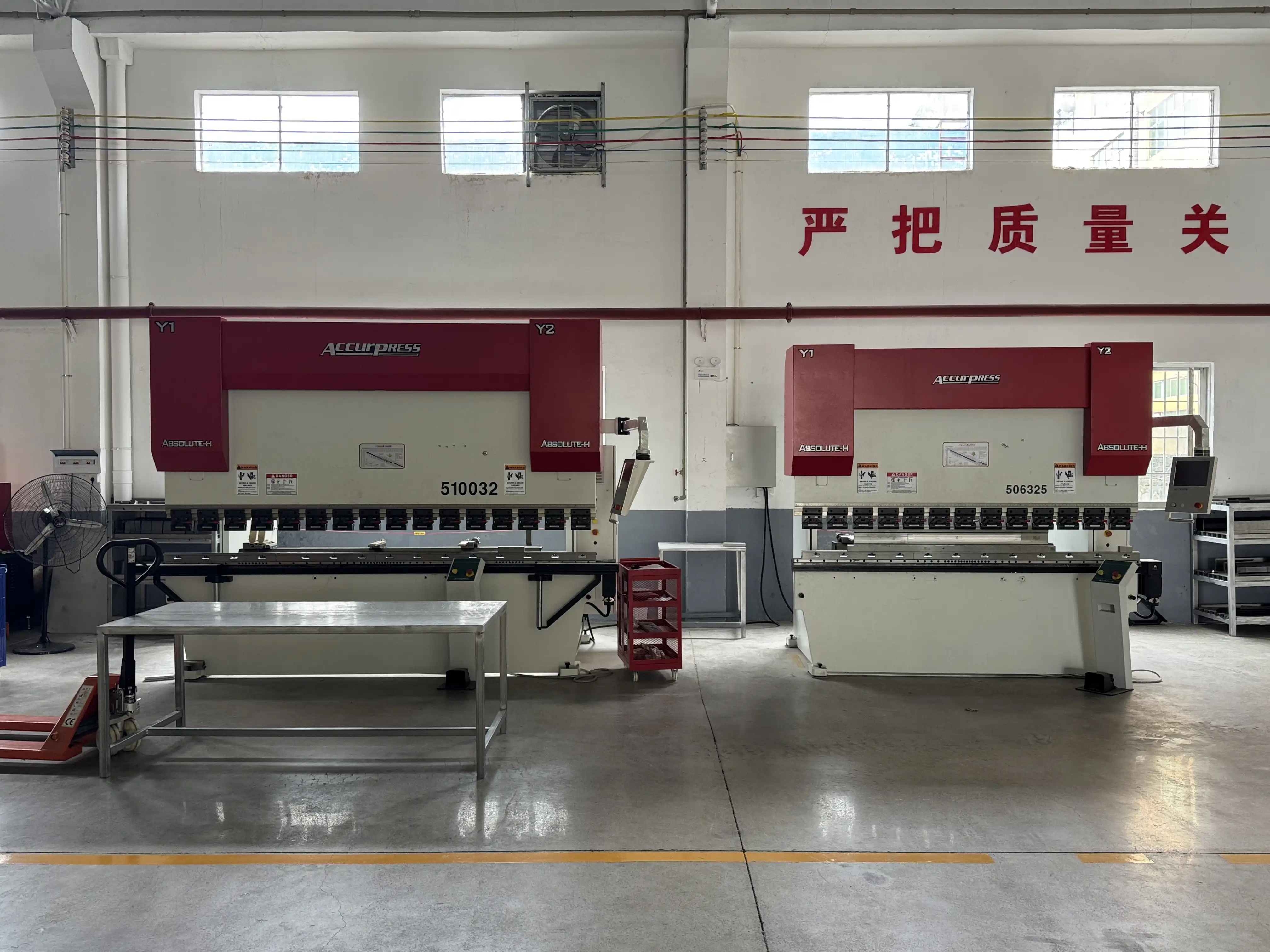
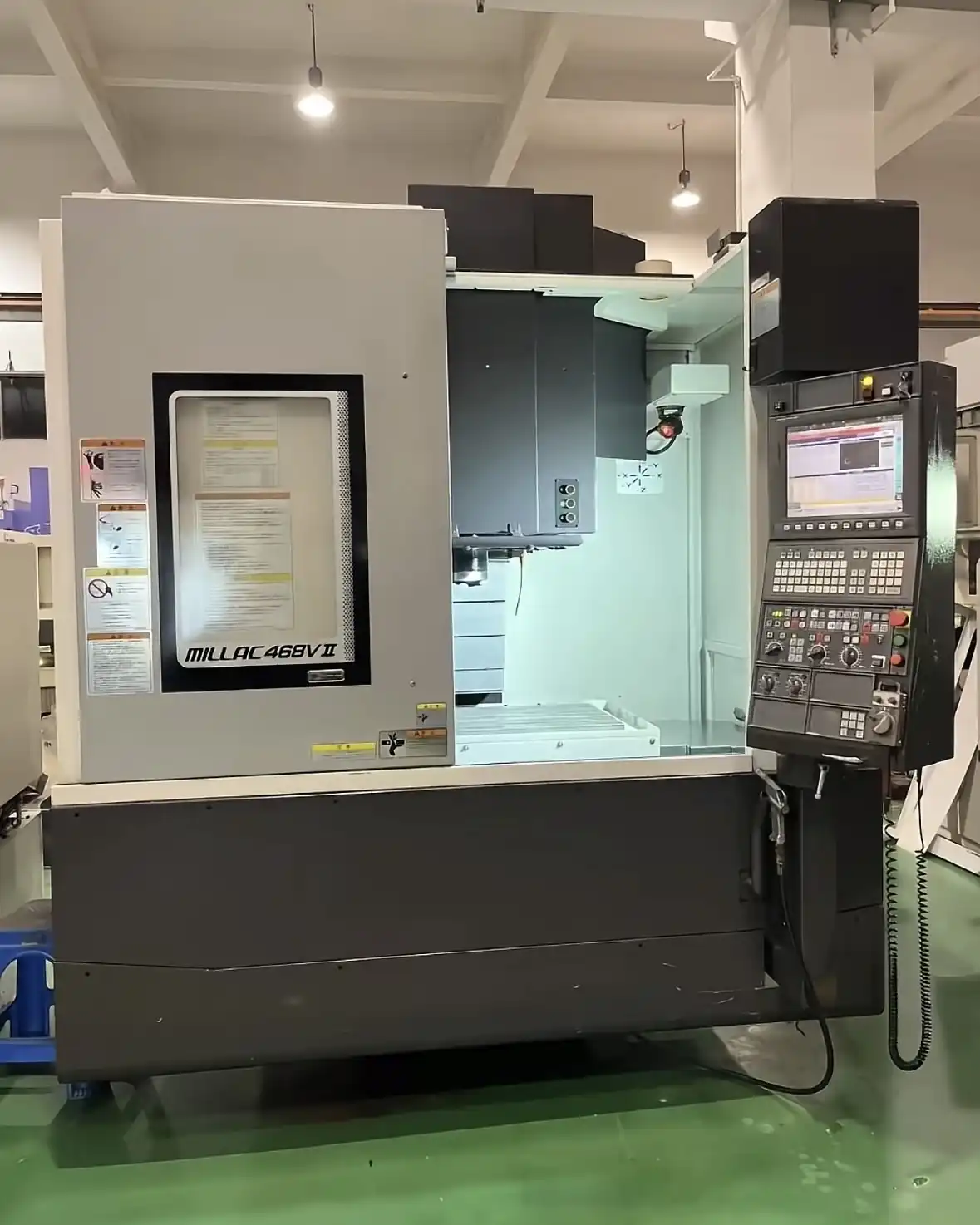
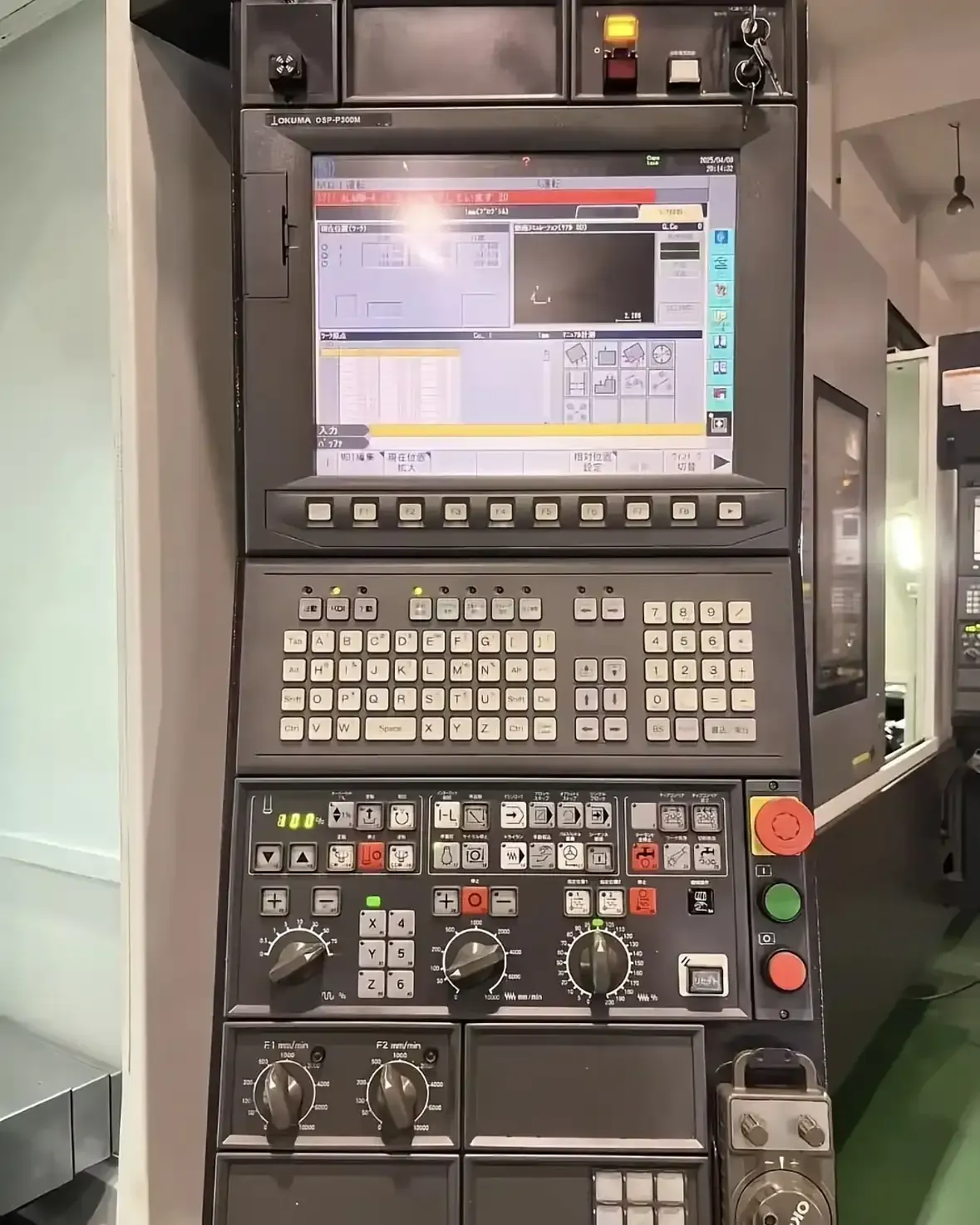
Processed aluminum panels are formed using CNC-controlled bending equipment.
The KASENDE factory uses a large CNC press brake to produce consistent bending positions and angles.
This improves the accuracy of structural parts and helps maintain product consistency across different production batches.
Bending accuracy directly affects:
Canopy shape and appearance
Structural rigidity
Door-frame alignment
Panel-to-panel fit
Seal installation
Final assembly quality
If the bending angle is inconsistent, the left and right sides of the canopy may become asymmetrical.
If the bending position is inaccurate, the gaps between doors and frames may become too large or too narrow.
CNC bending provides a more stable foundation for later assembly and helps improve the overall fit and finish of the completed canopy.
4. Refined Folded Edges and Detailed Finishing
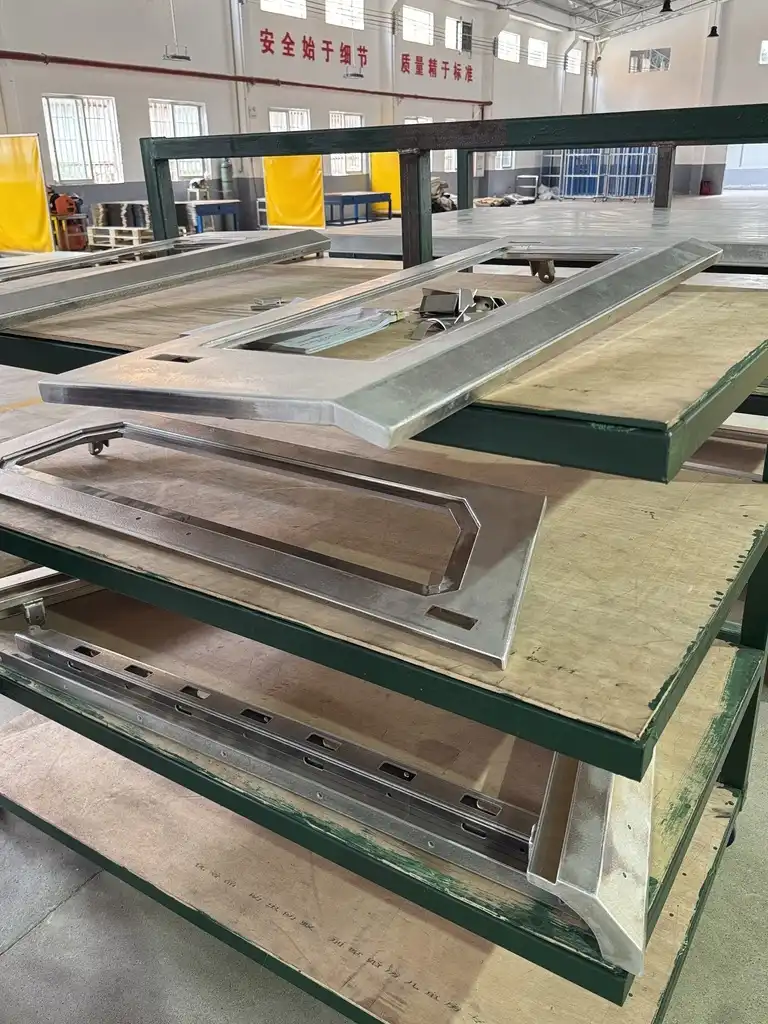
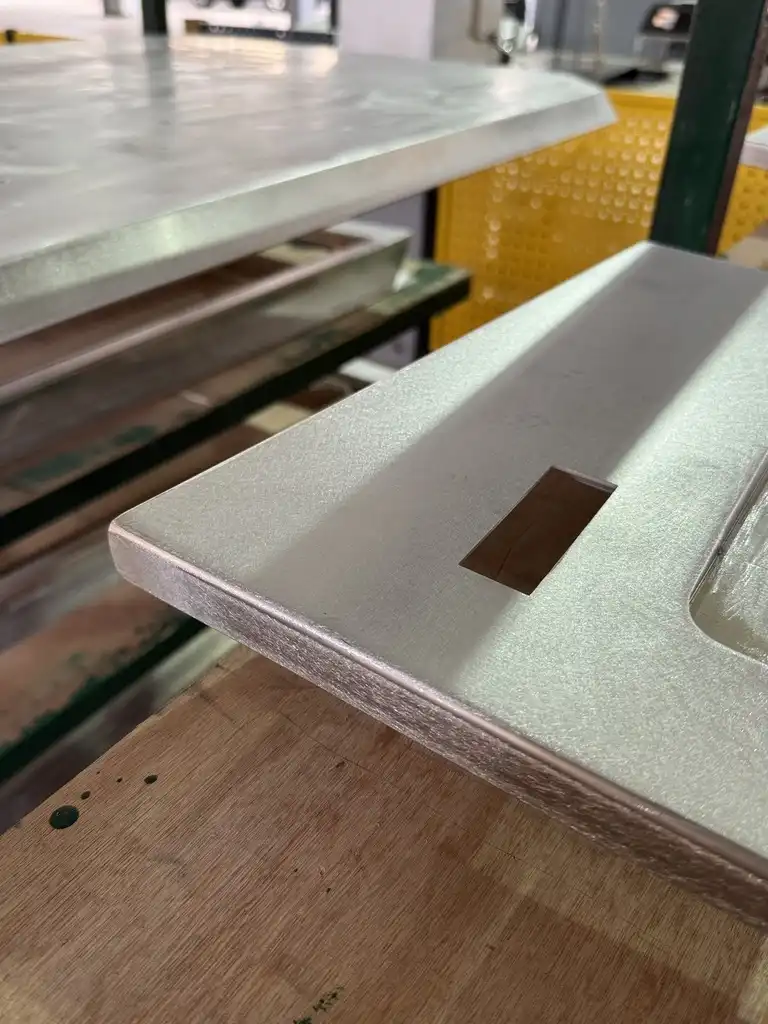
The edges of our aluminum components are carefully folded and formed.
This process is not only for appearance. A properly folded edge can improve local rigidity, reduce panel deformation and create a more suitable contact surface for seals and connecting parts.
It can also reduce exposed sharp edges in areas frequently touched by the customer.
KASENDE pays close attention to details such as:
Door-panel edges
Window and access openings
Frame corners
Folded sections
Lock openings
Hinge mounting areas
Seal contact surfaces
The objective is to create smooth edges, consistent corners, accurate openings and cleaner component alignment.
These details are often difficult to judge from a finished-product photograph, but they have a significant effect on installation quality and long-term performance.
5. In-Process Component Inspection
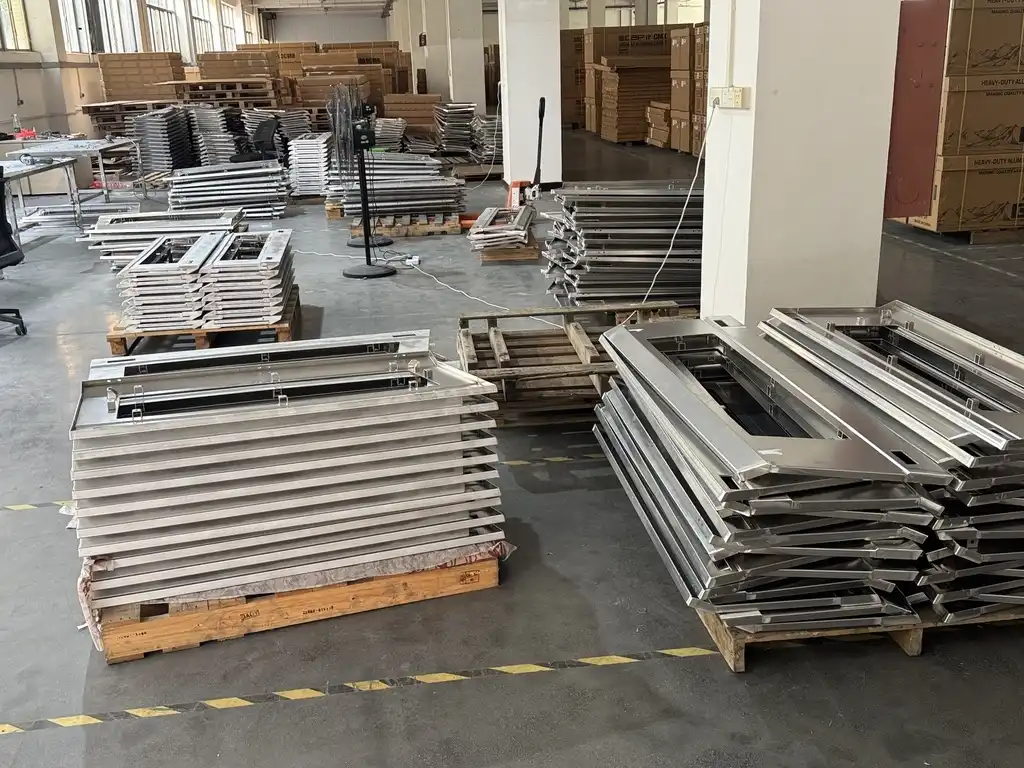
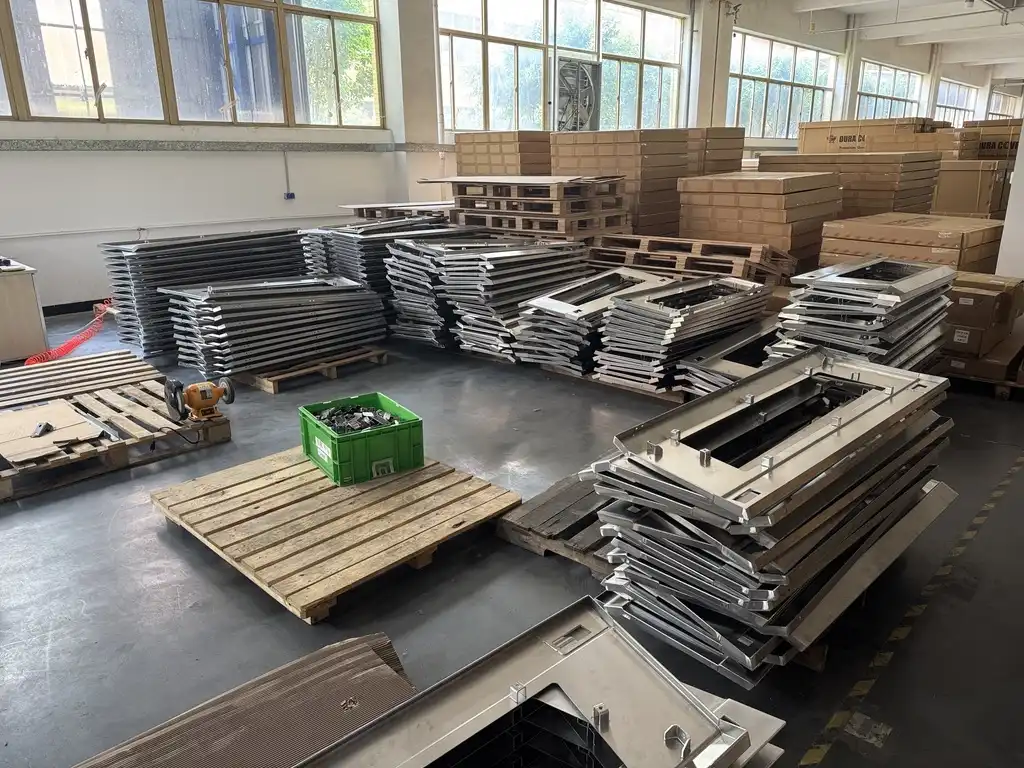
After forming, the aluminum doors, frames and structural panels are organized on production racks for inspection and assembly.
The inspection process may include checking:
Whether the component matches the design drawing
Whether the left and right components are symmetrical
Whether the door panel matches its frame
Whether lock and hinge positions are accurate
Whether bending angles meet assembly requirements
Whether edges are smooth and properly formed
Whether the surface has visible scratches or deformation
Whether connected parts fit together correctly
In-process inspection allows production issues to be identified before surface finishing and final assembly.
Detecting an inaccurate panel or opening at this stage helps avoid more complicated rework after the entire canopy has been assembled.
6. Structural Assembly and Custom Configurations
Once the components have passed inspection, they enter the structural assembly stage.
Different customers require different canopy layouts. KASENDE therefore provides multiple configuration options for personal users, commercial customers, distributors and private-label brands.
Available options can include:
Side lift-up access doors
Solid aluminum side panels
Glass side or rear windows
Lockable tool compartments
Internal storage cabinets
Camping kitchen modules
MOLLE-style accessory panels
Interior LED lighting
Roof rails
Roof racks
Rooftop tent mounting systems
Customized locks and handles
Customers who require greater security can replace glass windows with solid aluminum panels that match the main canopy structure.
Camping and overlanding customers can add storage cabinets, kitchen modules and rooftop tent mounting systems.
Commercial customers can choose tool storage, divided compartments and large side-access doors for more efficient daily use.
7. Surface Finishing and Appearance Control
After the structural components have been processed and assembled, the canopy undergoes surface treatment and coating.
A consistent coating contributes to both appearance and outdoor protection.
During this stage, attention is given to:
Surface uniformity
Coating coverage
Edge and corner finishing
Color consistency
Overall texture
Resistance to outdoor exposure
KASENDE can provide different colors according to customer and market requirements.
For OEM and ODM projects, we can also support:
Customer logos
Private-label branding
Product labels
Customized packaging
Market-specific configurations
This enables importers, wholesalers and automotive accessory brands to establish a recognizable product line rather than selling an unbranded generic product.
8. Sealing and Water-Resistance Testing
A pickup canopy is regularly exposed to rain, vehicle washing, dust, humidity and changing outdoor conditions.
For this reason, sealing performance is an important part of the production and inspection process.
Key sealing areas include:
Door frames
Window openings
Panel joints
Lock positions
Hinges
Structural connections
Contact surfaces between the canopy and truck bed
Depending on the product model and project requirements, KASENDE can conduct water-resistance testing for up to approximately 244 hours.
The purpose of this testing is to inspect doors, openings, joints and connection areas for abnormal water penetration.
Final water resistance also depends on correct vehicle installation. The truck-bed contact surface should be clean and level, sealing materials should be installed completely, and all mounting points should be tightened according to the installation requirements.
9. Rooftop Tent Compatibility and Roof Load
For camping and overlanding customers, roof load capacity is an important consideration.
Applicable KASENDE aluminum pickup canopy models can provide a static roof load capacity of up to approximately 300 kg under specified conditions, including:
Correct canopy installation
Even load distribution
Suitable mounting hardware
A properly matched roof rack
Stationary vehicle use
Compliance with the vehicle’s payload limits
Compatible configurations can be used with:
Rooftop tents
Roof racks
Camping equipment
Luggage boxes
Recovery equipment
Other suitable outdoor accessories
Customers should distinguish between static and dynamic loads.
Static load refers to the weight supported while the vehicle is parked. Dynamic load refers to the forces placed on the canopy while the vehicle is moving, braking, turning or travelling over uneven terrain.
Before installing a rooftop tent, the capacities of the canopy, roof rack, mounting brackets, truck-bed mounting points and vehicle must all be considered.
10. Vehicle Fitment Confirmation
A pickup canopy should not be selected only by vehicle brand or model name.
The same pickup model may use different truck-bed dimensions depending on:
Model year
Sales market
Trim level
Cab configuration
Truck-bed length
Tailgate structure
For example, a Double Cab pickup may be available with either a 5-foot or 6-foot truck bed. Single Cab, Extra Cab and Club Cab versions normally use longer beds.
Before preparing a quotation or production drawing, KASENDE normally requests:
Vehicle brand
Vehicle model
Model year
Cab type
Truck-bed length
Truck-bed width
Photos of the truck bed
Photos of the tailgate
Required canopy configuration
Delivery city and postal code
Canopy solutions can be produced for popular pickup platforms such as:
Toyota Hilux
Toyota Tacoma
Ford Ranger
Ford F-150
Mitsubishi L200
Isuzu D-Max
Nissan Navara
Nissan Frontier
Chevrolet Montana
Chevrolet Silverado
GMC Sierra
Volkswagen Amarok
Mazda BT-50
Other regional pickup models
Final compatibility must be confirmed using the exact vehicle specifications.
11. OEM and ODM Pickup Canopy Manufacturing
KASENDE provides OEM and ODM manufacturing services for international customers.
OEM manufacturing is suitable for distributors and brands that want to sell established canopy designs under their own brand name.
ODM development is suitable for customers requiring a customized product structure, appearance, internal layout or functional system.
Customization options can include:
Canopy dimensions
Aluminum panel structures
Side-door configurations
Rear-door designs
Solid aluminum or glass panels
Internal storage cabinets
Camping kitchen modules
MOLLE-style panels
Roof racks
Rooftop tent mounting systems
LED lighting
Locking systems
Surface colors
Customer logos
Product labels
Packaging
Our OEM and ODM services are suitable for:
Importers
Wholesalers
Pickup accessory distributors
Automotive modification companies
Off-road equipment brands
Camping equipment businesses
Fleet operators
Regional retailers
Customers developing a new market can begin with one sample unit for product display, installation evaluation and local market testing.
After the sample has been approved, wholesale and bulk production can be arranged according to the customer’s sales plan.
Why Work Directly with KASENDE?
Working directly with an aluminum pickup canopy factory reduces unnecessary distribution layers and allows technical requirements to be communicated directly to the production team.
KASENDE can provide:
Factory-direct quotations
OEM and ODM customization
Single-unit sample support
Wholesale and bulk production
Vehicle fitment confirmation
Production photos and videos
Custom branding and packaging
International shipping assistance
Long-term product development support
Price is important, but it should not be the only consideration when choosing a pickup canopy supplier.
Buyers should also evaluate material quality, structural design, cutting accuracy, bending consistency, edge finishing, locks, hinges, seals, coating, packaging and fitment support.
A low purchase price offers limited value if the canopy arrives damaged, does not fit the vehicle or cannot perform reliably in outdoor conditions.
How to Request a Quotation
To receive an accurate product and shipping quotation, please provide:
Vehicle brand and model
Vehicle model year
Cab type
Truck-bed length
Truck-bed width, if available
Photos of the truck bed and tailgate
Required canopy configuration
Destination country
Delivery city
Postal code
Personal-use or wholesale requirement
KASENDE will use this information to confirm the appropriate canopy configuration and calculate the estimated product and shipping costs.
Conclusion
The quality of an aluminum pickup canopy begins long before the final coating is applied.
It begins with aluminum sheet preparation and continues through precision panel processing, CNC bending, edge forming, inspection, structural assembly, surface finishing, sealing and water-resistance testing.
For personal users, a reliable pickup canopy creates more secure storage and greater possibilities for work, camping and travel.
For distributors and private-label brands, working with an experienced aluminum truck canopy factory provides access to OEM, ODM and stable production support.
To request a quotation, send KASENDE your vehicle model, model year, cab type, truck-bed dimensions, required configuration and delivery postal code.
KASENDE — Professional Aluminum Pickup Canopy Manufacturer.
Built for Work. Ready for Adventure.
Frequently Asked Questions
Is KASENDE an aluminum pickup canopy manufacturer?
Yes. KASENDE manufactures aluminum pickup canopies, truck canopies, truck caps and related pickup accessories for personal users, importers, distributors, wholesalers and automotive modification businesses.
Does KASENDE support OEM and ODM production?
Yes. OEM and ODM options include customized dimensions, structures, doors, internal layouts, colors, logos, labels, accessories and packaging.
Can a KASENDE canopy support a rooftop tent?
Applicable models can support compatible rooftop tent systems when the canopy, roof rack, mounting system and vehicle are correctly matched. Selected configurations can provide a static roof load capacity of up to approximately 300 kg under specified conditions.
Does KASENDE conduct water-resistance testing?
Yes. Depending on the product and project requirements, water-resistance testing can last up to approximately 244 hours.
Can side windows be replaced with aluminum panels?
Yes. Customers can select glass windows or fully enclosed aluminum side and rear panels.
Can storage cabinets or a camping kitchen be added?
Yes. Available options include storage cabinets, tool compartments, camping kitchens, MOLLE-style panels, lighting and roof systems.
Can I purchase only one canopy?
Yes. Personal customers can purchase one unit. Distributors and commercial buyers can also order a sample before arranging wholesale production.
What information is required to confirm fitment?
Please provide the vehicle brand, model, year, cab type, truck-bed dimensions and clear photos of the truck bed and tailgate.